The short answer
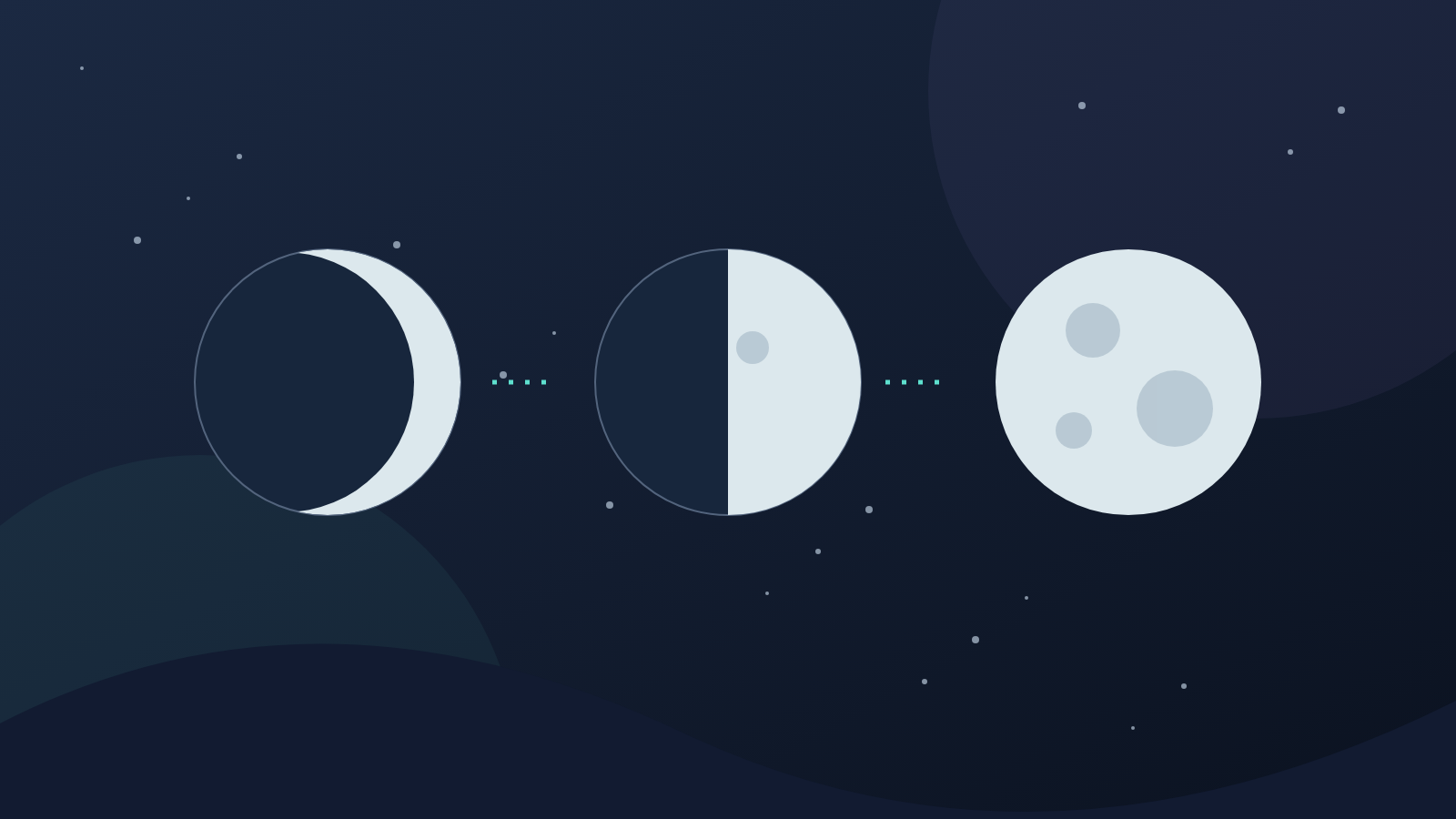
The Moon is not changing its physical shape. As it orbits Earth, we see different amounts of its sunlit half. Those changing views are the phases: crescent, quarter, full, and the stages between.
A thin crescent above the rooftops and a bright full Moon can look like entirely different objects. They are views of the same world, with sunlight and our position doing the work.
Moonlight begins with the Sun
The Moon shines by reflected sunlight. Outside an eclipse, roughly half of it is illuminated, while the other half is in night. Our view of that illuminated half changes around its orbit. NASA’s Moon phases guide shows the geometry.
What the phase names describe
- New Moon: The illuminated side faces mostly away from Earth.
- Crescent: A narrow portion of the lit side is visible.
- Quarter: About half the visible disk is illuminated.
- Gibbous: More than half the visible disk is illuminated.
- Full Moon: Almost all the visible disk is illuminated.
Waxing means the illuminated portion we see is growing; waning means it is shrinking. The cycle from one new Moon to the next takes about 29.5 days. See NASA’s phase descriptions.
Is Earth’s shadow making the crescent?
Ordinary phases are changes in viewing geometry. Earth’s shadow is involved in a lunar eclipse, when Earth lies between the Sun and Moon and the Moon passes through that shadow. Eclipses are a different event. NASA explains the distinction on its eclipse page.
Why someone else’s Moon may look tilted
People around Earth see the same phase at a given time, but its orientation can look different from different locations. Also, the far side is not a permanently dark side: it receives sunlight too. NASA addresses both questions in Top Moon Questions.
Keep a small Moon notebook
Our suggestion: over several evenings when the Moon is visible, sketch the lit shape and record the date, time, and where you looked. Add a note for clouds or an obstructed view rather than guessing. You are making a record of what you observed, not trying to draw a perfect lunar map.
Compare the sketches with the linked NASA guide. Can you see a pattern across several observations? Start with the shape; the names become easier once they describe something you have noticed for yourself.
Sources reviewed October 22, 2026. Astronomy explanations checked against NASA resources. The illustration is conceptual, not a scale diagram or a prediction of tonight’s Moon.