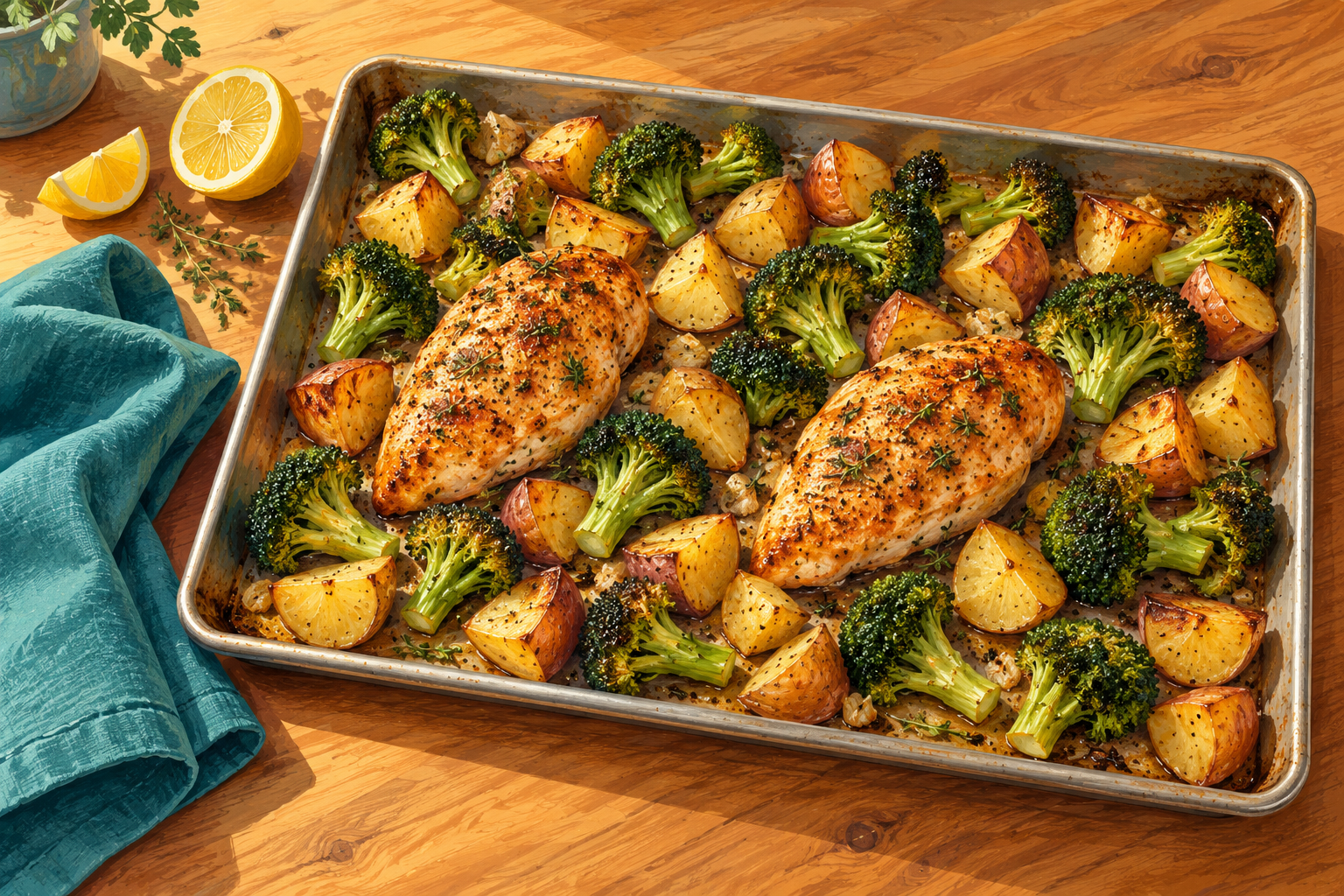
Recipe note: These recipes have not yet been kitchen-tested. Timings are estimates; use the doneness checks and food temperatures below. The cover is an AI-generated illustration, not a photograph of a tested dish.
Kitchen Sense · Understand the method, then make it your own.
A tray of roasted vegetables and a main ingredient can make a satisfying dinner with relatively little washing up. The part that takes practice is getting everything ready at roughly the same time.
Potatoes need a head start. Fish usually needs less time. Crowded vegetables may soften before they develop much colour.
Once you understand those differences, sheet-pan cooking becomes easier to adapt.
Start with space and timing
Use a large, rimmed metal baking tray, approximately 33 × 46 cm, or 13 × 18 inches. The rim helps contain oil and cooking juices.
Spread ingredients in a single layer with some room between them. If they are piled on top of one another, use a second tray or cook a smaller batch. Leave space for hot air to move around the food.
The recipes below use a conventional oven at 220°C / 425°F. Follow your appliance’s guidance when adapting for a fan or convection oven. If you use parchment, check that it is rated for this temperature.
Prepare vegetables in reasonably even pieces. Dry washed produce before adding oil, and coat it lightly rather than leaving oil pooled on the tray.
Use the clock as a reminder to check
Cooking times vary with ingredient thickness, tray material, and oven performance.
For these recipes, follow Health Canada’s internal-temperature guidance: 74°C / 165°F for chicken pieces and 70°C / 158°F for fish. Measure in the centre of the thickest part with a clean digital food thermometer, checking each piece separately. Health Canada: Safe cooking temperatures
Keep raw meat and fish separate from ready-to-eat ingredients during preparation. Wash hands and clean equipment after handling them, and use clean utensils for serving.
Dinner 1: Lemon Chicken, Potatoes, and Broccoli
Serves 2 · Allow about 55–65 minutes, including preparation.
This dinner teaches a useful habit: add ingredients in stages.
You’ll need
- 2 small boneless, skinless chicken breasts, about 150–180 g each
- 350 g potatoes, cut into approximately 2 cm pieces
- 250 g broccoli, cut into medium florets
- 2 tablespoons olive oil, divided
- 1 teaspoon dried oregano
- ½ teaspoon garlic powder
- ½ teaspoon paprika
- ½ teaspoon fine salt, divided, or less to taste
- Black pepper
- 1 lemon
Make it
- Heat the oven to 220°C / 425°F. Toss the potatoes with 1 tablespoon of oil, the paprika, and about half the salt. Spread them on the tray and roast for 15 minutes.
- Coat the chicken with ½ tablespoon of oil, the oregano, garlic powder, pepper, and a little of the remaining salt. Turn the potatoes, make space for the chicken, and return the tray to the oven for 10 minutes.
- Toss the broccoli with the remaining ½ tablespoon of oil and any remaining salt. Carefully add it around the other ingredients.
- Roast for approximately another 15–20 minutes. Check that each chicken breast has reached 74°C / 165°F and that the potatoes are tender. Continue cooking as needed; leave food that has contacted raw chicken juices on the tray until fully cooked.
- Transfer the cooked chicken to a clean plate and let it rest for about five minutes. Squeeze lemon juice over the meal just before serving.
What to notice: The potatoes receive more cooking time than the broccoli. That same principle helps whenever a meal combines dense vegetables with quicker-cooking ingredients.
Dinner 2: Salmon with Broccoli and Sweet Pepper
Serves 2 · Allow about 35–45 minutes, including preparation.
Here, the vegetables go in first and the fish joins them later.
You’ll need
- 2 fully thawed salmon fillets, about 150–180 g each
- 250 g broccoli florets
- 1 large sweet pepper, cut into broad strips
- 1½ tablespoons olive oil, divided
- ½ teaspoon garlic powder
- ½ teaspoon dried dill, or 1 tablespoon chopped fresh dill
- ¼–½ teaspoon fine salt, to taste
- Black pepper
- 1 lemon
Make it
- Heat the oven to 220°C / 425°F.
- Toss the broccoli and pepper with 1 tablespoon of oil, the garlic powder, and a little salt and pepper. Spread them on the tray and roast for 10 minutes.
- Carefully turn the vegetables and make two spaces for the salmon. Place the fillets skin-side down, if they have skin.
- Brush the salmon with the remaining oil. Add the dill and a little salt and pepper.
- Return the tray to the oven for approximately 12–18 minutes, checking earlier for thin fillets. Cook until each fillet reaches 70°C / 158°F in its thickest part.
- Serve with lemon wedges. Add bread or another accompaniment if you would like a more substantial meal.
What to notice: Two fillets can be the same weight but have different thicknesses. Check each one rather than assuming they will finish together.
Dinner 3: Smoky Chickpeas with Cauliflower and Peppers
Serves 2 generously · Allow about 40–50 minutes, including preparation.
Canned chickpeas make this an approachable starting point: they are already cooked, so the roasting is about warming them through and developing flavour and texture.
You’ll need
- 1 can chickpeas, approximately 398–425 g, drained and rinsed
- 300 g cauliflower, cut into small florets
- 1 large sweet pepper, cut into broad strips
- ½ medium red onion, cut into wedges
- 2 tablespoons olive oil
- 1 teaspoon smoked paprika
- ½ teaspoon ground cumin
- ½ teaspoon garlic powder
- ¼–½ teaspoon fine salt, to taste
- Black pepper
- ½ lemon
For serving
- ½ cup plain yogurt, or an unsweetened dairy-free alternative
- Flatbread or pitas
Make it
- Heat the oven to 220°C / 425°F.
- Pat the drained chickpeas dry with a clean towel. Dry the vegetables after washing.
- Toss the chickpeas, cauliflower, pepper, and onion with the oil, paprika, cumin, garlic powder, salt, and pepper.
- Spread them across the tray in a single layer. Use a second tray if necessary.
- Roast for approximately 25–35 minutes, turning after about 15 minutes. Look for tender cauliflower and browned edges. The chickpeas may become lightly crisp in places; they do not need to be crunchy throughout.
- Stir a squeeze of lemon juice into the yogurt. Serve it alongside the roasted mixture and flatbread.
What to notice: Drying the ingredients and giving them space helps their surfaces roast. If the tray is crowded, expect a softer result.
When everything finishes at a different time
That happens. Cooking involves adjusting.
Once meat or fish is safely cooked, move it to a clean plate while vegetables finish. If vegetables are browning too quickly, turn them and check the oven temperature. For another attempt, cut slow-cooking vegetables smaller or give them a longer head start.
Change one thing at a time so you can tell what helped.
Save the extra portions promptly
Transfer leftovers to shallow containers and refrigerate promptly, within two hours. Health Canada recommends eating refrigerated leftovers within two to three days or freezing them, and reheating them to 74°C / 165°F. Health Canada: Food safety tips for leftovers
Choose the dinner that appeals to you most, and pay attention to how it behaves in your oven. Your notes on timing, piece size, and seasoning will make the next tray easier.
Cover illustration: AI-generated for MagniftySense.